
Key facts
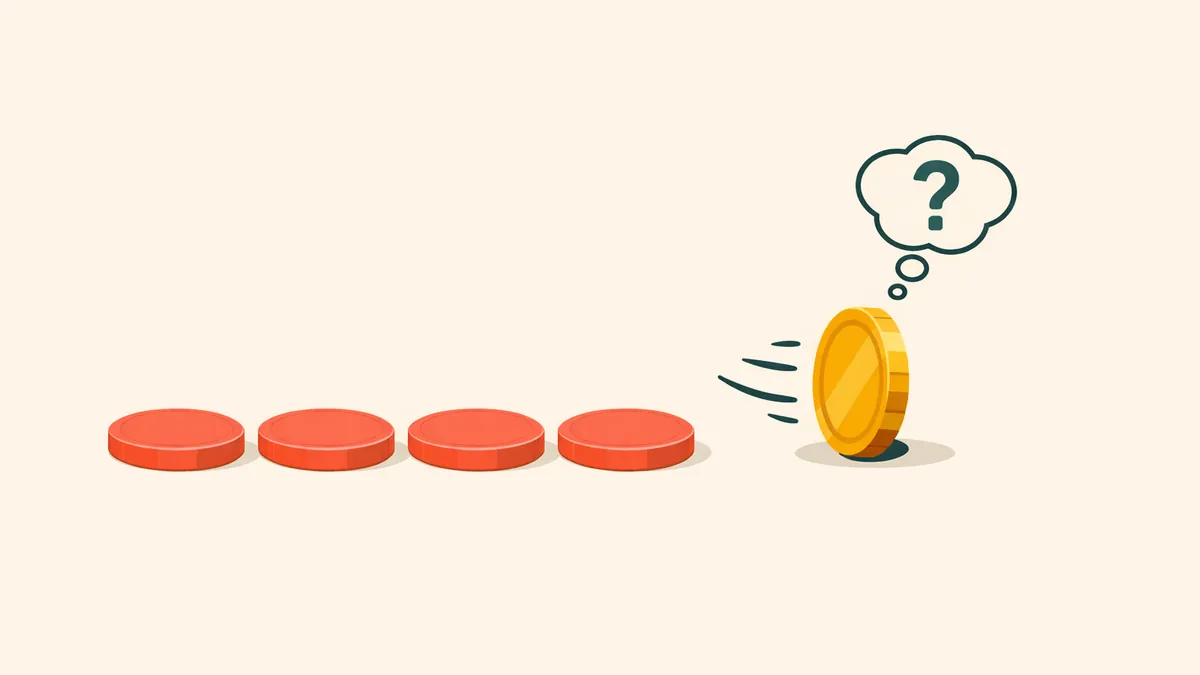
- The gamblers fallacy is the belief that a result becomes more likely because it has not happened for a while. On a fair wheel every spin is independent, so the chance of red is 18 in 37 (48.65%) whatever came before.
- Ten reds in a row from a standing start is about a 1 in 1,347 event, but after nine reds the tenth is still 48.65%.
- Long streaks are normal: in our simulation a run of 8 or more of one colour appeared in 47.1% of 200-spin stretches.
- Hot and cold numbers are noise. Over 100 spins each number averages 2.7 hits, yet some number hits 6 or more times 91.9% of the time, and about 2.4 numbers never appear at all.
- Results do not even out in money terms: over 37,000 spins the red share is very close to 48.6%, but the typical gap between red and its expected count grows to about 96.
What the gamblers fallacy is
The gamblers fallacy is the belief that a random outcome becomes more likely because it has not happened recently, or less likely because it just did. At a roulette table it sounds like "black has come up seven times, red is due". It is wrong because a roulette wheel has no memory. Victoria's gambling regulator puts it in one line: "Each game on a poker machine or spin on a roulette wheel is independent." And: "What happened before doesn't affect what happens next."
On a single zero wheel, 18 of the 37 pockets are red. That is the chance of red on the next spin, every spin, forever: 48.65%.
The odds after a streak
The confusion comes from mixing up two different questions. "How likely is a run of ten reds?" is a question about the future, asked before any spins. "How likely is red, given nine reds just happened?" is a question about one spin.
| Reds so far | Chance of this whole streak, from scratch | Chance the next spin is red |
|---|---|---|
| 3 | 11.5% (1 in 8.7) | 48.65% |
| 5 | 2.7% (1 in 37) | 48.65% |
| 7 | 0.64% (1 in 155) | 48.65% |
| 9 | 0.15% (1 in 655) | 48.65% |
| 10 | 0.074% (1 in 1,347) | 48.65% |
By the time you are watching the ninth red, the rare part has already happened. The tenth spin starts fresh. The same applies in reverse: after nine reds, black is not more likely either.
Long streaks are normal
People treat a long run as a sign that something must change. In practice long runs happen all the time. We simulated 100,000 stretches of 200 spins on a single zero wheel and recorded the longest run of one colour (a zero breaks the run):
| Longest run of one colour in 200 spins | How often |
|---|---|
| 6 or more | 94.5% |
| 8 or more | 47.1% |
| 10 or more | 13.7% |
So a scoreboard showing eight blacks in a row is close to a coin flip in any couple of hundred spins. It tells you nothing about spin 201. This is precisely the moment a Martingale strategy player doubles again, because surely red is due; it is also the moment the doubling ladder runs out.
Hot and cold numbers
Casinos often show recent results next to the wheel. Tasmania's approved roulette rules even define the device: a winning number display, "recording and displaying the present and most recent winning numbers spun at the table". Players read those boards for hot numbers (hitting often) and cold numbers (absent for ages). Here is what pure chance produces on a fair 37-pocket wheel.
Hot numbers, 100 spins. Each number should appear 2.7 times on average. In our simulation of 100,000 sessions:
| Hottest number in 100 spins | How often |
|---|---|
| Hit 6 or more times | 91.9% |
| Hit 7 or more times | 53.9% |
| Average hits for the hottest number | 6.7 |
A number hitting seven times in 100 spins looks hot. It happens in more than half of all sessions with a perfectly fair wheel.
Cold numbers. The chance a particular number misses a stretch of spins, in our calculation:
| Spins | Chance one chosen number never appears | Numbers you can expect to be missing |
|---|---|---|
| 37 | 36.3% | 13.4 of 37 |
| 74 | 13.2% | 4.9 |
| 100 | 6.5% | 2.4 |
| 200 | 0.42% | 0.2 |
After 37 spins, about a third of the board is "cold" by definition. Betting the cold numbers does not change their odds: each is still 1 in 37 next spin.
Pundit tip: if you catch yourself saying "due", swap it for "1 in 37". It sounds less exciting because it is accurate.
Does it even out in the long run?
The law of large numbers is real, but it is not a correcting force. It works by dilution, not by payback. Percentages settle down as spins pile up; the raw gap between what happened and what was expected does not shrink at all. It typically grows.
| Spins | Red share, 95% of the time between | Typical gap from the expected red count |
|---|---|---|
| 37 | 32.5% and 64.8% | 3.0 reds |
| 370 | 43.6% and 53.7% | 9.6 reds |
| 3,700 | 47.0% and 50.3% | 30.4 reds |
| 37,000 | 48.1% and 49.2% | 96.1 reds |
A player waiting for red to "catch up" after a black-heavy hour is waiting for something the maths never promised. The only thing that reliably evens out is the house edge, which collects 2.70% of everything bet on a single zero wheel. See our European roulette guide for where that number comes from.
The fallacy outside roulette
The same error drives "this pokie hasn't paid in ages". The VGCCC's guidance on poker machines says it directly: "There is no pattern, cycle or 'due win'." Each spin of a pokie is picked by a random number generator, as our how pokies work guide explains, and electronic roulette works the same way; the testing rules behind that are in our random number generator casino guide.
Why it matters for your money
The gamblers fallacy is not just a curiosity. It is the belief that keeps people betting bigger after losses: "it has to turn". The VGCCC's myths page notes that people sometimes think they can spot patterns in games like keno or roulette, and answers: "This isn't possible." If you find yourself chasing losses, our gambling help page lists free, confidential support, including Gambling Help Online on 1800 858 858.
Roulette is legal in Australia at licensed casinos only; online roulette cannot be offered to Australians, as covered in our online roulette Australia guide.
Our partner sites
Terms checked 8 to 9 October 2026We earn a commission if you join through these links; it pays for the site and does not change the facts we show. Listed in no particular order. Every detail comes from the casino's own terms, except ACMA notes, which come from ACMA's blocked list. These are offshore casinos without an Australian licence, so BetStop and Australian dispute services do not cover them: read whether online pokies are legal in Australia and our affiliate disclosure.Commission links. Offshore sites with no Australian licence or BetStop cover: is it legal?

LuckyOnes
Partner · termsTerms checked 9 Oct 2026- Withdrawals
- AUD 6,000 a day
- Max bet (bonus)
- AUD 8
- Min deposit
- AUD 30
- Names no licence or operating company in its terms or footer
- luckyones.com, luckyones1.com and luckyones7.com are on ACMA's blocked list (8 Oct 2026)Main domain on ACMA's blocked list

Wild Tokyo
Partner · termsTerms checked 8 Oct 2026- Withdrawals (entry)
- AUD 800 a day
- Max bet (bonus)
- AUD 8
- Monthly cap (entry)
- AUD 13,000
- States a Curacao eGaming licence (no number shown)
18+ Offers and terms change often; the casino's own terms always apply. Never gamble money you need. Free help: Gambling Help 1800 858 858, 24/7.
Frequently asked questions
What is the gamblers fallacy?
It is the mistaken belief that past results change the odds of independent future ones, for example that red is due after a run of black. On a single zero roulette wheel the chance of red on any spin is 18 in 37, about 48.65%, no matter what has happened before.
Are hot and cold numbers real in roulette?
No. A scoreboard of recent numbers always shows some numbers hit several times and some not at all, because that is what random results look like. In our simulation of 100-spin sessions, the most frequent number averaged 6.7 hits against an expected 2.7, with no bias in the wheel.
Does roulette even out in the long run?
Percentages settle down; counts do not. Over 37 spins the share of reds commonly ranges from about 32% to 65%, and over 37,000 spins from 48.1% to 49.2%. But the typical difference between the actual and expected number of reds grows from about 3 to about 96.
Is the hot hand the same as the gamblers fallacy?
It is the mirror image. The gamblers fallacy says a streak must end; the hot hand belief says it will continue. On an independent game both are wrong, because the next spin has the same odds either way.
Can a casino wheel be biased?
Approved Australian rules control the equipment and the spin. Tasmania's and the ACT's rules require the ball to be spun against the wheel and to complete at least three revolutions, and in Victoria's approved rules it is four, or the spin is void. You cannot detect bias from a scoreboard of recent numbers, which is what the fallacy relies on.
Related reading
 Casino games European roulette European roulette is the single zero game, and it is the standard wheel in Australian casinos. Here is the wheel itself, the sector bets that follow its number order, and what the odds mean over a real session. Read more
  Casino games Evolution Gaming Evolution makes many of the live dealer tables and game shows streamed online. Here is the company from its own 2025 annual report: its size, how it earns, where the money comes from and its licences. Read more
  Casino games Random number generators Pokies, electronic roulette and online table games all get results from a random number generator. Here is how an RNG works, the tests Australian and UK standards require, and how a careless one would cheat you. Read more
  Casino games Dragon Tiger Dragon tiger is baccarat cut down to one card per side. The whole price of the main bet sits in one rule: what happens to your bet when the two cards tie. Here are the rules and the numbers. Read more
  Casino games French roulette French roulette is the single zero game with French terms and, at some tables, a rule that returns half your even-money bet on zero. That halves the edge. Here is how it works, and why an Australian table may lack it. Read more
  Casino games Martingale strategy Double after every loss and one win gets it all back. That part is true. What the Martingale never tells you is how often the ladder runs out, and what it costs when it does. Here are the numbers at $5 a bet. Read more
 Sources
Official pages we relied on. If anything here has changed, tell us via the contact page and we fix it.