
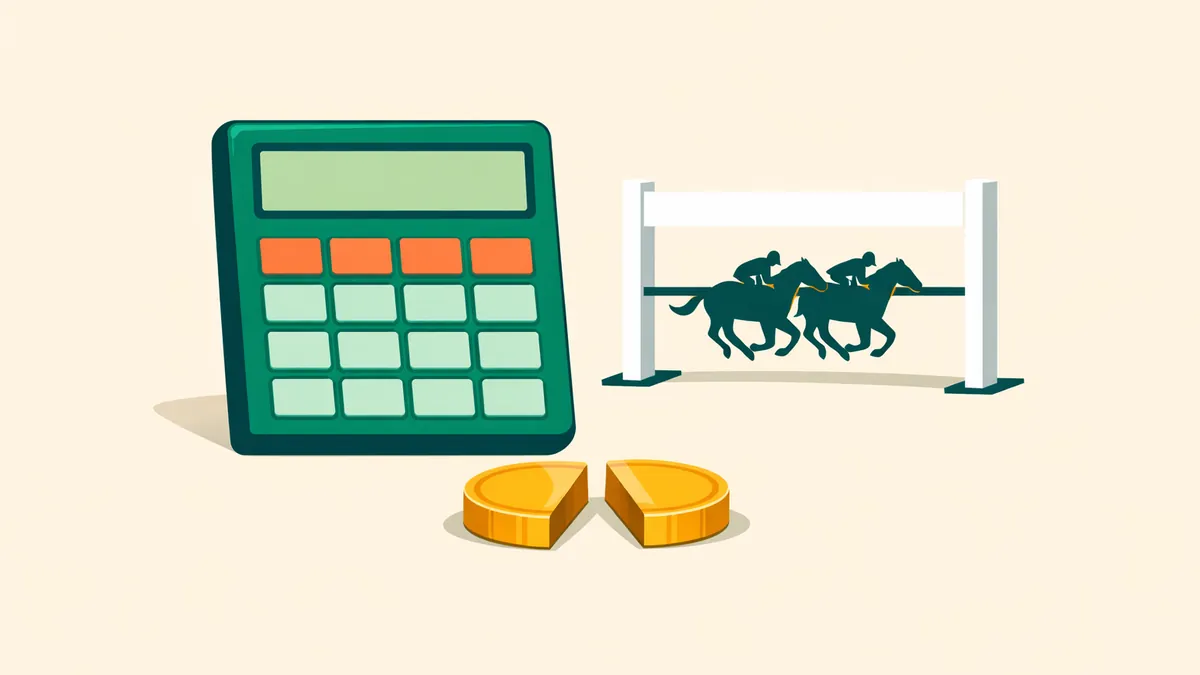
Dead heat calculator
- Share of the payout
- -
- Return
- -
- Profit or loss
- -
- Without the dead heat
- -
Key facts
- Fixed odds dead heat payout = stake x odds x paid places shared / runners in the dead heat.
- In our calculation, $20 to win at $5.00 in a two-way dead heat for first pays $50 instead of $100, a $30 profit.
- A tie inside the places can still pay in full: two runners dead heating for second on a 3 place bet both fill a paid place.
- Sportsbet's racing terms say a dead heat payout will not be less than your stake. On the tote, the TAB says win and third place dividends in a dead heat cannot be less than your bet.
How to use the dead heat calculator
Enter your stake and the fixed odds you took, how many runners finished in the dead heat, the place they tied for, and how many places your bet pays: 1 for a win bet, 2 or 3 for a place bet depending on field size, or more for a top 4, top 10 or top 20 market. If your bookmaker guarantees your stake back on a dead heat, set the minimum payout. The calculator shows your share of the payout, the return, the profit or loss and what the bet would have paid without the tie.
This is a calculator for fixed odds bets. Tote dividends are calculated from the pool by the TAB after the race, so you read them off the results rather than work them out yourself.
The dead heat formula
The NSW rules for bookmaker declared betting events set out the method in two steps: divide the full payout "by the number of competitors involved in the tie, draw or dead heat", then multiply by "the number of official placings to be filled". As one line:
dead heat payout = stake x odds x paid places shared / runners in the dead heat
Paid places shared is how many of the tied positions fall inside the places your bet pays. Two runners dead heating for 3rd on a 3 place bet share 1 paid place. Two runners dead heating for 2nd on the same bet occupy 2nd and 3rd, so they share 2 paid places and each is paid in full. Sportsbet's racing terms describe the same idea: the payout, "including the initial stake", is "divided by the number of competitors drawing for that placing".
Worked example: a two-way dead heat for first
You have $20 to win on a horse at $5.00. It dead heats for first with one other runner.
- Full payout without the tie: $20 x 5.00 = $100.
- Paid places shared: the two runners tie for 1st and a win bet pays 1 place, so 1.
- Dead heat payout: $100 x 1 / 2 = $50.
- Profit: $50 - $20 = $30, instead of $80.
Those are the calculator's default inputs. In effect, half your stake is treated as a winning bet at $5.00 and the other half as a losing one.
Dead heat payouts at a glance
All on a $20 stake, in our calculation:
| Bet | Dead heat | Paid places shared | Payout | Profit or loss |
|---|---|---|---|---|
| Win at $5.00 | 2 runners for 1st | 1 of 2 | $50.00 | +$30.00 |
| Win at $5.00 | 3 runners for 1st | 1 of 3 | $33.33 | +$13.33 |
| Place at $2.40, 3 places paid | 2 runners for 3rd | 1 of 2 | $24.00 | +$4.00 |
| Place at $2.40, 3 places paid | 2 runners for 2nd | 2 of 2 | $48.00 | +$28.00 |
| Place at $2.40, 3 places paid | 3 runners for 2nd | 2 of 3 | $32.00 | +$12.00 |
| Place at $2.40, 2 places paid | 2 runners for 2nd | 1 of 2 | $24.00 | +$4.00 |
| Win at $1.60 | 2 runners for 1st | 1 of 2 | $16.00 | -$4.00 |
The last row is the trap. A short-priced winner in a two-way dead heat returns less than you staked, unless your bookmaker guarantees the stake. Sportsbet's racing terms do: "Payout on dead heat selection/s will not be less than the customers stake". Other bookmakers set their own rules, so check yours.
Each way bets and dead heats
An each way bet is two bets, and each half is settled on its own. Say you have $10 each way at $9.00 to win and $2.60 to place, and your horse dead heats for first with one other runner in a field paying 3 places. The win half pays $90 / 2 = $45. The place half is not cut at all, because the two runners fill 1st and 2nd and both are inside the places, so it pays the full $26. In our calculation you get back $71 from $20. Run each half through the calculator separately, or see the each way calculator for the normal case.
On the tote
Tote bets are not divided the same way, because the dividend comes from the pool. The TAB says that in a win dead heat "The Win pool is split and dividends are paid to both winners", and "The Win dividends cannot be less than a customer's bet." A dead heat for first or second still pays three place dividends. A dead heat for third pays four, and the third place pool is split between the two runners, again with a dividend no lower than your bet. Our guide to tote vs fixed odds covers how pool dividends are formed.
Pundit tip: a dead heat is most expensive on a short-priced runner. The rule halves your payout, not your profit, so the shorter the price, the bigger the share of your stake it eats.
Dead heats in multis and golf
In a multi, the dead heat leg is recalculated first and the rest of the multi stands. Under clause 5.1.9 of the NSW declared betting events rules, each leg's revised return uses the dead heat method and the payout is the product of the legs. A $10 two-leg multi at $3.00 and $2.00, where the $2.00 leg dead heats two ways for first, has that leg settled at $1.00, so the multi returns $30 in our calculation. Enter the reduced leg price in the multi bet calculator to check yours.
Golf place markets get a clause of their own: the same NSW rules apply the dead heat method to golf place bets that tie after the set number of holes, which matters in top 5, top 10 and top 20 markets where players can finish level on the last paid places. Five players tied for 9th in a top 10 market share 2 paid places, so a $10 bet at $4.00 pays $40 x 2 / 5 = $16. Our guides to dead heat rules and golf betting go further into how each market is settled, and the deductions calculator handles the other common change to a racing payout, a late scratching.
Frequently asked questions
How is a dead heat paid out?
On a fixed odds bet the full payout, stake included, is divided by the number of runners in the dead heat and multiplied by the number of paid places they share. A $20 bet at $5.00 in a two-way dead heat for first pays $100 / 2 = $50.
Do you lose money on a dead heat?
You can. A dead heat halves a two-way tie, so a winner at under $2.00 returns less than your stake: $20 at $1.60 pays $16. Some bookmakers, including Sportsbet in its racing terms, guarantee you will not get back less than your stake.
What happens to a place bet in a dead heat for third?
Two runners share one paid place, so a fixed odds place bet on either of them is paid at half. On the tote, the TAB pays four place dividends and splits the third place pool between the two dead heaters.
Does a dead heat affect a multi?
Yes. The dead heat leg is settled at its reduced odds and the multi carries on. Under the NSW bookmaker rules for declared betting events, each affected leg is recalculated with the dead heat method and the payout is the product of the legs.
How do dead heats work in golf top 10 betting?
Players can finish level on the last paid places. If five players tie for 9th in a top 10 market, they share two paid places, so each bet is paid at two fifths of the full payout.
Related reading
 Calculator Quinella calculator A quinella pays if you pick the first two in any order. See what any quinella box costs, your flexi percentage and what you collect. Read more
  Calculator Boxed trifecta calculator Work out what a boxed or standout trifecta costs, your flexi percentage for any outlay, and what you collect when the dividend is declared. Read more
  Calculator Deductions calculator When a runner is scratched after you bet, your fixed odds payout gets cut by a set number of cents in the dollar. Enter the deduction your bookmaker announces and see your real price and return. Read more
  Calculator Arbitrage calculator Enter the best price for every outcome, taken from different bookmakers. If they add up to under 100%, see the stake on each side and the profit you lock in whatever happens. Read more
  Calculator Expected value calculator Expected value is what a bet wins or loses on average if you could place it thousands of times. Compare the price with the chance you believe in, and see whether the bet is worth anything. Read more
  Calculator System bet calculator Enter your selections, odds and results to see how many lines a system bet has, what it costs and what it pays back. Works for every named full-cover bet and any custom mix of doubles, trebles and bigger. Read more
 Sources
Official pages we relied on. If anything here has changed, tell us via the contact page and we fix it.