
Key facts
- Stopping works best in layers: cut off access, put distance between you and money, plan for urges and get support.
- Urges pass if you wait them out. Gambling Help Online's 5Ds are Delay, Distract, Deep breathe, Decide and Discuss.
- Common triggers include debts, stress, arguments, alcohol, boredom and being around people who are winning.
- A slip is not the end. Plan your high-risk situations in advance and restart the same day.
- Free counselling is available in every state. Call 1800 858 858 at any hour to be connected.
The plan in one table
The most reliable way to stop gambling is to make it hard to do, make money hard to reach, and have a plan ready for the moment an urge hits. No single step does all three, so use several together.
| Step | What you do | Why it helps |
|---|---|---|
| 1. Decide and tell someone | Pick a start day and tell one person you trust | Saying it out loud makes it real and gives you backup |
| 2. Cut off access | Self-exclude, block sites, close accounts | Removes the easy option in a weak moment |
| 3. Protect your money | Limit cash and cards, let someone help manage it | An urge without money attached is easier to ride out |
| 4. Plan for urges | Learn the 5Ds and write your own urge plan | Urges pass if you do not act on them |
| 5. Map your triggers | List what sets you off and what you will do instead | Most gambling follows a pattern |
| 6. Fill the gap | Plan what you will do with the time and money | Stopping leaves a hole that boredom will try to fill |
| 7. Get support | Counsellor, GP, peer forum or helpline | People who stop with support are less alone when it gets hard |
Step 1: decide, then tell one person
Choose a day to stop, ideally soon, and tell one person who will not judge you. It might be a partner, a friend, a sibling or a counsellor on 1800 858 858. You do not have to explain everything at once. "I am stopping gambling and I might need help" is enough.
Step 2: cut off access
Make gambling physically harder to reach before you rely on self-control. Register with BetStop for licensed online bookmakers, ask about venue self-exclusion for pubs and clubs, turn on your bank's gambling block if it has one, install blocking software, and close any casino accounts. Each covers different ground, and our self-exclusion guide shows what each one blocks and what it misses.
Delete gambling apps, unsubscribe from marketing, and remove saved logins and cards from your browser. Small frictions matter most in the first weeks.
Step 3: protect your money
When gambling is the problem, access to money is the fuel. The Victorian government's Better Health Channel suggests:
- limiting how much cash you carry and can withdraw
- having a trusted person help manage day-to-day money for a while
- telling family and friends what is going on and asking them not to lend you money
- considering moving important assets, such as a car or property title, to a partner or trusted person
If debts are part of the picture, a free financial counsellor can help you plan repayments and deal with creditors. The National Debt Helpline is 1800 007 007. Licensed bookmakers must also offer binding limits, which our gambling deposit limits page explains, but if your goal is to stop, closing the account is stronger than limiting it.
Step 4: plan for urges with the 5Ds
An urge feels like it will never end, but Gambling Help Online points out that it does fade if you wait long enough without acting. The 5Ds give you something to do while it passes.
| D | In practice |
|---|---|
| Delay | Put the decision off for 10 minutes, then another 10. You can always decide later |
| Distract | Do something that takes your full attention: a walk, a call, a shower, a game with the kids |
| Deep breathe | Slow breathing for a minute or two to calm the rush |
| Decide | When the delay is up, choose what you actually want, not what the urge wants |
| Discuss | Tell someone about the urge, or start a chat with a counsellor |
A worked example. Write a short urge plan on your phone's lock screen: "Wait 10 minutes. Walk to the corner shop and back. Text Sam. If it is still strong, call 1800 858 858." The aim is to make the first move automatic, so you are not deciding from scratch while the urge is at its peak.
Step 5: map your triggers
Most gambling follows a pattern: the same feelings, places, people or times of day. Gambling Help Online lists the common triggers below. Mark the ones that fit you and write your own response next to each.
| Trigger | A plan that helps |
|---|---|
| Worrying about debts | Make a budget, see a financial counsellor, stop trying to win it back |
| Unpleasant feelings | Find other ways to relax; a GP or counsellor can help with stress or low mood |
| Arguments or conflict | Step away, cool down, consider relationship counselling |
| Peer pressure | Practise a line such as "I've decided not to gamble anymore" and suggest something else |
| Being around wins | Learn the real odds; the gambler's fallacy explains why a win is never "due" |
| Needing excitement | Plan new activities with a bit of adrenaline or challenge |
| Alcohol or drugs | Avoid mixing them with gambling settings; plan this one with a counsellor |
| Payday or a windfall | Pay bills and move savings first, on the day the money arrives |
Step 6: fill the gap
Gambling often takes up hours each week. If nothing replaces that time, boredom becomes a trigger. Plan specific things for the times you used to gamble: exercise, a class, catching up with people who do not gamble, a project with a clear goal. Put the money you would have spent somewhere you can watch it grow.
It can help to see the number. At $20 a day, a year of gambling is $7,300 put through, in our calculation. For pokies, the pokies calculator shows what an hour of play costs on average at any bet size.
Step 7: get support
Stopping is easier with people in your corner. Options include:
- Gambling Help, 1800 858 858: free, confidential, 24/7, and can refer you to ongoing counselling.
- Online chat and email through Gambling Help Online, plus self-help modules and a peer forum.
- Your GP, who can refer you to psychological treatment. healthdirect notes that cognitive behaviour therapy may help overcome gambling addiction.
Our gambling addiction counselling page lists the services in each state. If you are not sure how serious things are, the signs in our gambling addiction guide are a useful check.
If you slip
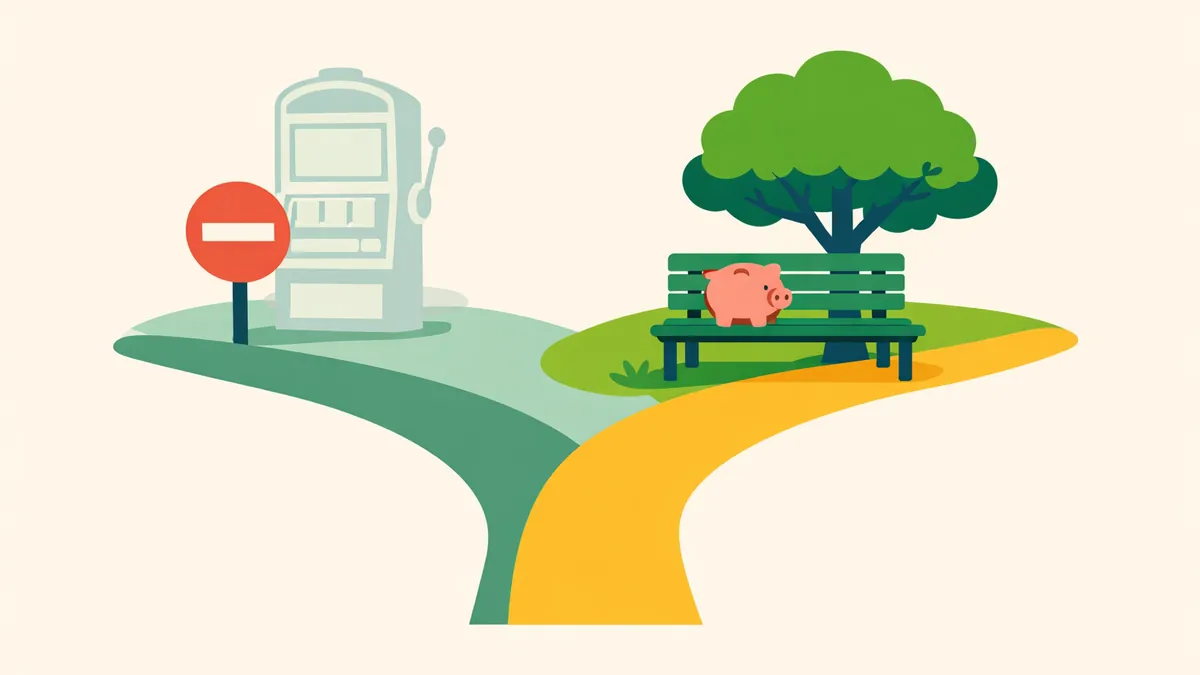
A slip, or lapse, happens to many people who stop. What matters is what you do next. Gambling Help Online suggests planning ahead for high-risk situations: avoid them where you can, and have a specific strategy ready where you cannot. It describes these moments as forks in the road, where a concrete plan lets you choose the other path.
After a lapse:
- Stop and move away from the gambling as soon as you notice.
- Work out what led to it: the time, the place, the feeling, the money.
- Add that situation to your trigger list with a better plan.
- Tell your support person or call 1800 858 858.
- Restart today, not on Monday.
Pundit tip: do not try to win back what you lost in the slip. Chasing is how a single lapse becomes a relapse.
If you feel overwhelmed, Lifeline is on 13 11 14, 24/7. More services are listed on our gambling help Australia page.
Frequently asked questions
How do I stop gambling addiction?
Combine several steps rather than relying on willpower: block gambling sites and venues, hand over control of spare money, plan how you will handle urges and triggers, and get support from a counsellor or someone you trust. Free counselling starts with a call to 1800 858 858.
What do I do when I get an urge to gamble?
Delay the decision, even for a few minutes, and do something else while you wait. Gambling Help Online's 5Ds (Delay, Distract, Deep breathe, Decide, Discuss) are built on the fact that urges pass if you do not act on them.
Can I stop gambling on my own?
Some people do, but support makes it much more likely to last. Gambling Help Online has free self-help modules and a peer forum, and a counsellor can help you build a plan around your own triggers.
What should I do if I gamble again after stopping?
Treat it as a lapse, not a failure. Work out what led to it, change your plan for that situation and tell someone. A call to 1800 858 858 the same day can help you get back on track.
How do I stop gambling online?
Register with BetStop for licensed Australian bookmakers, then close the gaps it leaves: a bank gambling block, blocking software and closing any casino accounts. Our self-exclusion guide explains each tool.
Related reading
 Guide Gambling laws Australian gambling regulation has two layers: Canberra decides what can be sold online, and the states and territories license everything else. Here is how the pieces fit, with a guide for every jurisdiction. Read more
  Guide Gambling counselling Gambling counselling costs nothing in Australia, and you can start tonight by phone or chat. Here is every way in, the service in your state and what actually happens in a session. Read more
  Guide Gambling addiction Gambling addiction means you keep gambling even when it is hurting you. Here are the signs health services look for, how common it is in Australia, and the free help that is open right now. Read more
  Guide Family and friends When someone you love gambles too much, you need support too. Here is how to raise it, what helps and what enables, how to protect shared money, and the free services that are there for you. Read more
  Guide Self-exclusion BetStop blocks you from every licensed Australian bookmaker for 3 months up to life. Here is how it works, what it does not cover, and the other tools that close the gaps. Read more
  Guide Deposit limits Every licensed Australian betting account must let you set a binding deposit limit. Lowering it is instant, raising it takes a week. Here is how the rules work and how to choose a number you will stick to. Read more
 Sources
Official pages we relied on. If anything here has changed, tell us via the contact page and we fix it.